
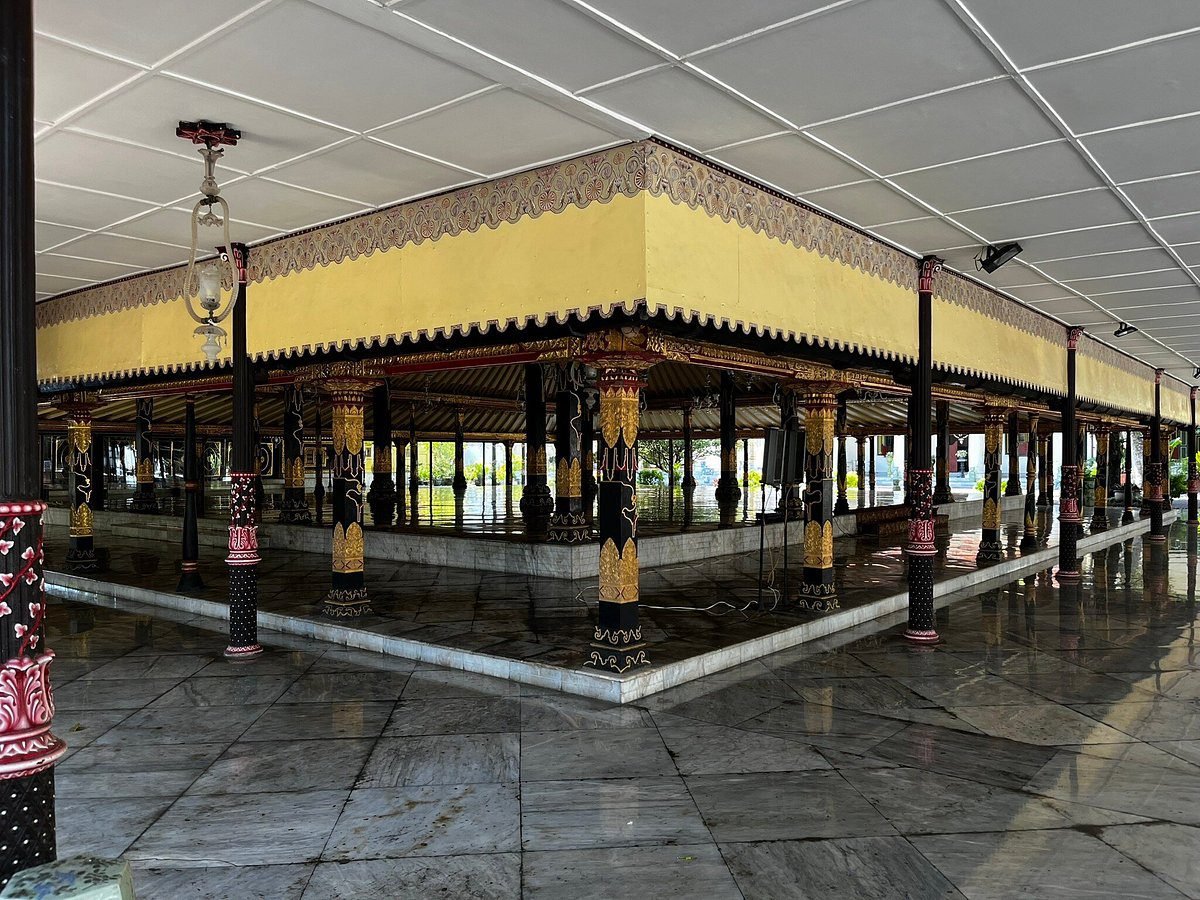
Quick answer: the historic centre of Yogyakarta fits into one walkable day. Start at the Kraton in the morning, walk 15 minutes to Taman Sari, then head north to Malioboro and Beringharjo market, and finish at Alun-Alun Kidul after dark. Everything is within 3 km, and a becak covers the gaps for a few dollars.
The five places that make up the old city
- Kraton — the Sultan’s palace, still a working royal residence
- Taman Sari — the Water Castle, a royal bathing and meditation complex
- Malioboro — the main street, best in the evening
- Beringharjo — the market for batik, snacks and everyday shopping
- Alun-Alun — the two palace squares, north and south, alive after dark
1. Kraton: start here
The Kraton is the reason the city exists. Sultan Hamengkubuwono X still lives inside the complex, and the courtyards, pavilions and museums are open to visitors on a working-palace basis.
Hours: Tuesday to Sunday, 08:30–14:30. Closed Monday. Tickets: from around Rp 15,000.
Allow one to two hours. Hire a guide at the gate — the pavilions are empty rooms without the stories, and the guide explains which courtyard is used for which ceremony. Dress modestly: shoulders and knees covered.
Full detail: the Kraton guide.
2. Taman Sari: the Water Castle
Fifteen minutes on foot west of the Kraton, Taman Sari was built in 1758 as a pleasure garden for the Sultan’s court: bathing pools, meditation rooms, an underground passage and a circular well that doubled as a mosque.
Hours: 09:00–15:00, last entry 14:30. Tickets: a few dollars.
Allow an hour. The site is smaller than the photos suggest, and the surrounding kampung is part of the experience — you walk through narrow lanes to reach the pools.
Full detail: the Taman Sari guide.
3. Malioboro: the evening street
Malioboro is the spine of the city and its living room. Batik shops, street musicians, food carts and the smell of fried snacks from late afternoon until midnight. It is free, and it is where locals actually spend their evenings.
Best time: after 17:00. Time needed: two to three hours, including dinner.
Walk the length, then turn into the side lanes for cheaper food. Bargain in the shops — the first price is rarely the real one.
Full detail: the Malioboro guide.
4. Beringharjo: the market
Beringharjo sits at the north end of Malioboro and has been the city’s market since the 18th century. The ground floor is food and everyday goods; the upper floors are batik, souvenirs and clothing.
Best time: morning to mid-afternoon, when the stalls are fully open. Time needed: one hour.
Buy batik here rather than on the street if you want to compare quality, and taste the snacks — yangko, bakpia and dried fruit are sold by weight.
Full detail: the Beringharjo guide.
5. Alun-Alun: the palace squares
There are two. Alun-Alun Utara sits in front of the Kraton and is at its best during ceremonies. Alun-Alun Kidul, the southern square, is the one to visit at night: families, food stalls, and the famous LED-light pedal carts that teenagers race around the square.
Best time: after 19:00. Time needed: one hour.
Full detail: the Alun-Alun Kidul guide and the myth behind it.
The walking route, hour by hour
| Time | Place | Notes |
|---|---|---|
| 08:30–10:30 | Kraton | Go early, hire a guide |
| 10:30–11:00 | Walk to Taman Sari | 15 minutes through the kampung |
| 11:00–12:00 | Taman Sari | Last entry 14:30, but morning light is better |
| 12:00–13:00 | Lunch | Gudeg or nasi campur near the Kraton |
| 13:00–15:00 | Beringharjo | Batik and snacks |
| 15:00–17:00 | Rest | The heat peaks in the afternoon |
| 17:00–20:00 | Malioboro | Street food and shopping |
| 20:00–21:00 | Alun-Alun Kidul | Becak, 10 minutes from Malioboro |
How to move around the centre
Everything on this route is within 3 km, but the heat makes walking the whole thing unpleasant after 11:00. Use a becak (cycle rickshaw) for short hops — agree the price first — or Grab/Gojek for a dollar or two.
A private car is unnecessary inside the centre and often slower than a becak because of the one-way streets around Malioboro.
Practical tips
- Monday: the Kraton is closed, so start at Taman Sari instead.
- Dress: shoulders and knees covered at the Kraton and Taman Sari.
- Heat: do the palaces in the morning and the street in the evening.
- Ramadan: some food stalls close during the day and reopen after sunset.
- Cash: markets and becak still prefer it.
A short history of the old city
Yogyakarta was founded in 1755, when the Mataram Sultanate split in two and Sultan Hamengkubuwono I built a new capital here. The layout is still readable: the Kraton at the centre, the Alun-Alun in front of it, Malioboro running north towards the European quarter, and Taman Sari as the royal pleasure garden.
That axis — palace, square, street — is why the centre feels coherent. It was planned as a single idea, and the Dutch colonial buildings were later inserted along the same line. Walking the route is walking the city’s history in order.
Where to eat along the route
Morning: gudeg near the Kraton — young jackfruit, rice, chicken and an egg, eaten for breakfast by locals. Expect Rp 25,000–40,000.
Lunch: nasi campur or pecel in the lanes between the Kraton and Taman Sari, where the warungs serve the neighbourhood rather than tourists.
Afternoon: snacks in Beringharjo — yangko, bakpia and dried fruit, sold by weight.
Evening: Malioboro street food. Wedang ronde (ginger broth with glutinous rice balls) for dessert, and sate or fried rice from the carts.
Shopping: batik and souvenirs
Beringharjo is the place to compare batik. The ground floor is food and household goods; the upper floors are fabric, clothing and souvenirs. Prices are negotiable, especially for more than one piece, and hand-drawn batik costs several times more than stamped.
Malioboro is convenient but more expensive for the same goods. Buy small souvenirs there, and batik in the market.
For a deeper guide, read what to buy in Beringharjo and our souvenir centre guide.
When to visit the city centre
The dry season, May to September, is the most comfortable for walking. The rainy season brings afternoon downpours, which is another reason to do the palaces in the morning and the street in the evening.
Avoid the Kraton on Monday, and expect heavier crowds during Indonesian school holidays and the week of Lebaran. Ramadan changes the rhythm: some food stalls close during the day and everything comes alive after sunset.
Common mistakes
- Starting at 11:00. The Kraton closes at 14:30 and the heat peaks in the early afternoon.
- Doing the palaces on Monday. The Kraton is closed, and Taman Sari becomes the first stop instead.
- Walking the whole route at midday. Use a becak for the Taman Sari to Malioboro leg.
- Skipping the guide at the Kraton. The pavilions are empty rooms without the stories.
- Buying batik on Malioboro only. Beringharjo has more choice and better prices.
Alun-Alun Kidul at night: what to do
The southern square is a local evening out. Families come to eat, children ride the LED-light pedal carts, and the food stalls around the edge sell grilled corn, fried rice and sweet iced drinks. The two banyan trees in the middle are the subject of a popular ritual: blindfolded visitors try to walk between them, and legend says your wish comes true if you succeed.
Go after 19:00, when the lights are on. It is free to enter; the carts and food are paid separately. Allow an hour, and take a becak back to Malioboro rather than walking the dark side streets.
Getting to the centre
From Yogyakarta International Airport (YIA), the KAI Commuter train reaches the city in 35–40 minutes, and a taxi takes 60–90 minutes. From Tugu station, Malioboro is a five-minute walk; from Lempuyangan, it is a 15-minute becak ride.
If you are arriving by train and staying near Malioboro, you do not need a car for this route at all. See the airport guide for the transfer details.
Frequently asked questions
Can you walk between the Kraton, Taman Sari and Malioboro?
Yes. The Kraton to Taman Sari is 15 minutes on foot, and Taman Sari to Malioboro is about 20. The whole route is under 3 km.
Is the Kraton open every day?
No. It is open Tuesday to Sunday, 08:30–14:30, and closed on Mondays.
How much does the city centre cost to visit?
The Kraton and Taman Sari charge a few dollars each; Malioboro, Beringharjo and the alun-alun are free. Budget USD 10–15 for tickets, food and a becak.
What time is Malioboro best?
After 17:00, when the food carts and buskers come out. It stays busy until around midnight.
Is Alun-Alun Kidul worth visiting at night?
Yes, for the atmosphere and the LED carts. It is a local evening out rather than a monument, and it pairs naturally with dinner on Malioboro.
What should I wear in the city centre?
Light clothing, but cover shoulders and knees for the Kraton and Taman Sari. Comfortable shoes for the walking.
Where should I eat in the city centre?
Gudeg near the Kraton in the morning, street food on Malioboro in the evening, and the snacks in Beringharjo in between.
Do I need a guide for the city centre?
Not for Malioboro or the market. For the Kraton and Taman Sari, a guide at the gate is worth the small fee — the buildings are empty without the stories.