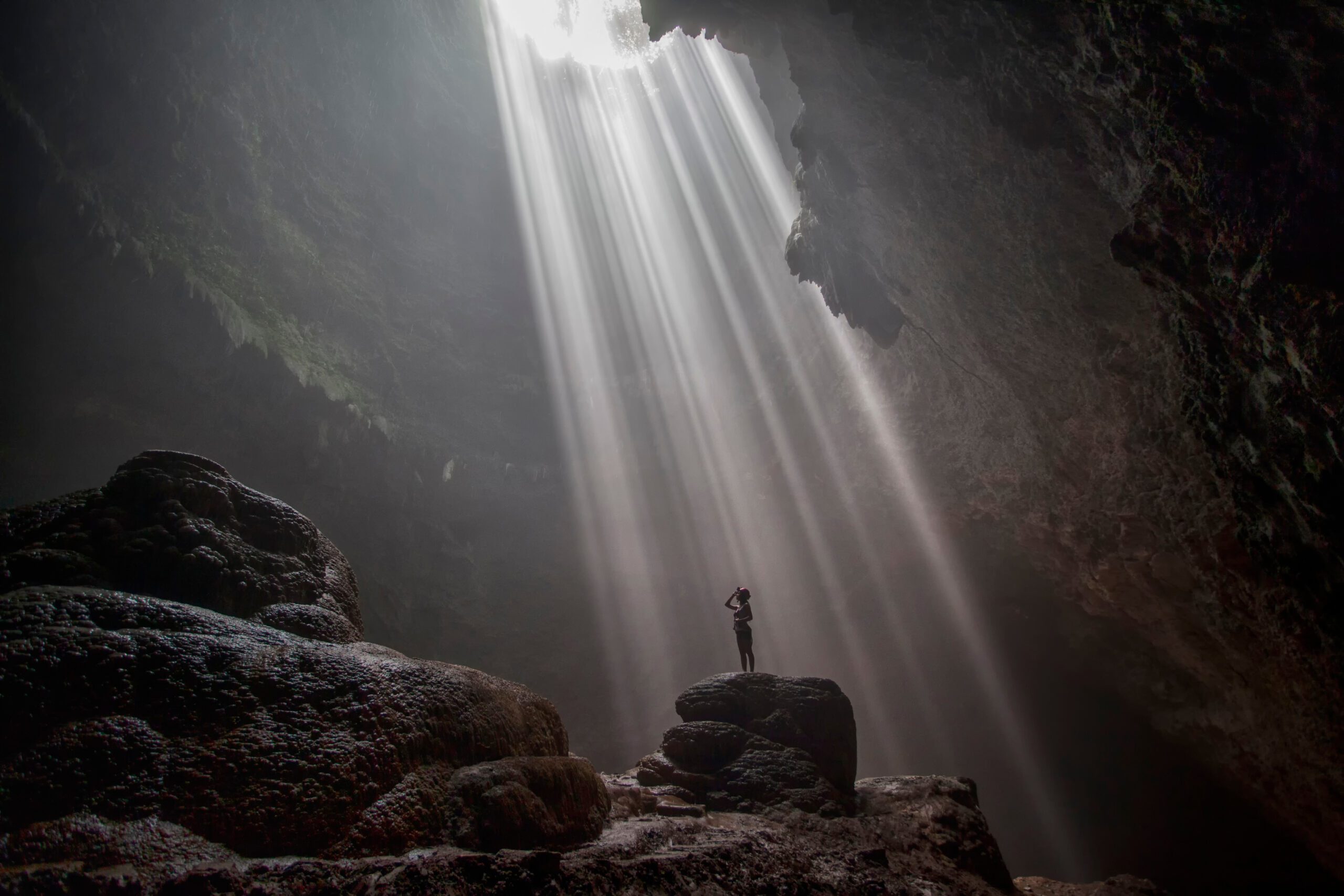
Quick answer: Jomblang is a vertical cave in Gunungkidul, about two hours from Yogyakarta. You descend 60 metres on a rope, walk through a forest passage, and reach a chamber where a beam of light falls through the ceiling between roughly 10:00 and 12:00. Tickets cost Rp 500,000, the site limits visitors to about 200 a day, and trips run in the morning only. Our Jomblang cave tour starts at USD 90 per person.
What Jomblang actually is
Jomblang is a sinkhole — a collapsed cave whose roof fell in thousands of years ago, leaving a vertical shaft open to the sky. At the bottom, a 270-metre passage runs through the limestone to a second chamber, and it is there that the light beam appears.
It is not a walk-in cave. You go down by rope with a guide, and you come back up the same way. That is the whole appeal: it feels like an expedition, but it only takes a morning.
The descent, step by step
- 08:00 — arrival and briefing. You sign in, are fitted with a harness and helmet, and change into rubber boots if you do not have proper shoes.
- 08:30 — the rappel. Guides control the rope from above and below. The descent is 60 metres and takes a few minutes; you do not need experience, only a head for heights.
- 09:00 — the passage. A short walk through mud and shallow water to the second chamber. This is the part that surprises people: it is wet, dark and uneven.
- 10:00–12:00 — the light beam. Sunlight falls through the opening in the ceiling and lights the chamber. This is the window you came for.
- 12:30 — ascent and lunch. You climb back up the rope, change, and eat at the simple warung at the entrance.
The light beam: when and how to see it
The beam only appears when the sun is high enough and the sky is clear. In practice that means late morning, roughly 10:00 to 12:00, and it is strongest around 10:30–11:00. On a cloudy day you may get a soft glow instead of a defined shaft.
Bring a camera that handles low light. Tripods are awkward on the muddy floor and you will be moving with a group, so a fast lens and a high ISO are more useful. Do not use flash — it kills the effect and annoys everyone else in the chamber.
Tickets, price and booking
| Item | Detail |
|---|---|
| Ticket | Rp 500,000 per person |
| Includes | Guide, harness, helmet, boots, locker, entrance |
| Daily quota | About 200 visitors |
| Operating hours | Morning only; the last descent is early afternoon |
| Booking | Required in high season; walk-ins risk being turned away |
Jomblang is run by the local village cooperative, not by a large operator, and the quota is enforced. In July, August and Indonesian holidays it sells out a day or two ahead. Booking through a tour also solves the transport, which matters because the cave is 60 km from the city.
What to wear and bring
- Clothes you do not mind getting muddy — you will get muddy
- Closed shoes with grip; boots are provided but sizing is limited
- A change of clothes and a plastic bag for the wet ones
- A small towel
- Cash for lunch and photos
- No loose jewellery or dangling straps near the rope
Fitness, age and who should skip it
You do not need climbing experience, but you do need to be comfortable on a rope and in enclosed spaces. The passage is low in places and the chamber is dark apart from the beam.
Skip Jomblang if you are claustrophobic, afraid of heights, pregnant, or travelling with very young children. Anyone with knee or shoulder problems should think twice about the ascent, which is the physically harder half.
How to get to Jomblang from Yogyakarta
The cave is in Jetis, Gunungkidul, about 60 km southeast of the city — roughly two hours by car. There is no practical public transport to the entrance, and tours leave early to secure a place in the quota.
If you are coming from the airport, read the airport-to-Jomblang route; if you are already in the city, the city-to-Jomblang guide covers the drive and timings. Coming from Jakarta? The Jakarta-to-Jomblang manual has the full itinerary.
Combining Jomblang with other places
Jomblang finishes around midday, which leaves the afternoon free. The usual combinations:
- Pindul Cave — tubing through an underground river, 30 minutes away, suitable for families. Our Jomblang and Pindul tour covers both from USD 105.
- Timang Beach — the cable car over the surf, about an hour east, usually paired with Jomblang on a full-day route.
- Prambanan — on the way back to the city, if you still have the energy. The Jomblang and Prambanan tour runs from USD 115.
Best time to visit
The dry season, May to September, gives the clearest light beam and the safest conditions. In the wet season the cave can flood and the passage becomes muddier; operations sometimes close after heavy rain.
Weekdays are quieter than weekends, and the first descent of the day has the best chance of clear light. If you are visiting in July or August, book ahead.
Mistakes to avoid
- Arriving without a booking in high season and finding the quota full.
- Wearing sandals — the passage is muddy and slippery.
- Expecting a walk-in cave — the rope descent is the whole point, and the climb back up is real effort.
- Carrying a big backpack — there is nowhere dry to put it, and it gets in the way on the rope.
- Planning an afternoon visit — the light beam is gone by early afternoon.
Jomblang tours and prices
| Tour | What is included | From |
|---|---|---|
| Jomblang cave tour | Hotel pickup, cave entry, guide, equipment | USD 90 |
| Jomblang and Pindul | Both caves, tubing, lunch | USD 105 |
| Jomblang and Prambanan | Cave in the morning, temples on the way back | USD 115 |
How the cave formed
Gunungkidul is karst country: a limestone plateau riddled with caves and underground rivers. Jomblang began as a cave system, and when its roof collapsed, it left a vertical shaft open to the sky — a sinkhole. Rainwater draining through the limestone carved the passage at the bottom and continues to shape it today.
That geology explains the mud. The cave floor is wet all year, the walls drip, and the passage floods when it rains hard upstream. It also explains why the light beam is so specific: the shaft has to be open to the right angle of the sun, which only happens in the middle of the day.
Jomblang, Pindul or Timang: which one fits you?
| Place | What it is | Effort | Best for |
|---|---|---|---|
| Jomblang | 60 m rope descent into a sinkhole | Medium — heights, mud, climb back up | Adventure, photographers, older children |
| Pindul | Tubing through an underground river | Low — sit in a ring, float | Families, non-swimmers, short trips |
| Timang | Cable car over the surf to a fishing rock | Low — but a long drive | Views, photography, combining with Jomblang |
If you have one day and want the story, choose Jomblang. If you are travelling with young children or someone nervous about heights, choose Pindul and add Timang for the view.
Facilities at the site
Jomblang is a village-run operation, not a resort. Expect a simple ticket office, a waiting shelter, basic toilets, changing rooms and lockers, a warung selling fried rice and noodles, and a shoe-rental counter. There is no proper café and no showers, so bring a towel and a change of clothes.
Phone signal is patchy at the bottom of the valley. Download your maps and tickets before you leave the city.
Photography at Jomblang
The beam is a single shaft of light in a dark chamber — a high-contrast scene that phones struggle with. Tap to expose for the light, not the walls, and expect the chamber to fall into shadow. If you are using a camera, f/2.8–f/4 at ISO 1600–3200 is a reasonable starting point.
Do not bring a tripod unless you have arranged it in advance: space is tight, the floor is slippery, and the group moves through in a line. A monopod or a beanbag is more practical.
What happens if it rains
Heavy rain can close the cave: the passage floods and the rope descent becomes unsafe. The cooperative cancels descents rather than risk it, and tours are rescheduled or refunded according to the operator’s policy.
In the wet season, book Jomblang for the first morning of your stay if possible, so you have another day to reschedule. Do not leave it for your last morning before a flight.
Is Jomblang worth it?
If you want a story you cannot get at the temples, yes. The descent, the mud, the dark passage and the beam of light are a genuinely unusual morning — and it is the kind of experience people remember longer than another viewpoint.
If you are short on time or uncomfortable underground, skip it without guilt: Yogyakarta has enough temples and volcanoes to fill the same day.
Frequently asked questions
How much does Jomblang Cave cost?
The entrance ticket is Rp 500,000 per person and includes the guide, harness, helmet and boots. Tours with transport start at USD 90.
What time is the light beam at Jomblang?
Roughly 10:00 to 12:00, strongest around 10:30–11:00, and only on a clear day.
Is Jomblang suitable for beginners?
Yes. You do not need climbing experience; guides control the rope. You do need to be comfortable with heights and enclosed spaces.
How deep is Jomblang Cave?
The shaft is about 60 metres deep, and the passage at the bottom runs roughly 270 metres to the light chamber.
How far is Jomblang from Yogyakarta?
About 60 km southeast, roughly two hours by car in Gunungkidul.
What should I wear to Jomblang?
Clothes you can get muddy, closed shoes with grip, and a change of clothes. Boots are provided.
Is Jomblang open every day?
It operates daily in the morning, but closes after heavy rain or when the cave floods. Confirm the day before in the wet season.
Can children do the Jomblang descent?
Older children who are comfortable with heights can, but very young children should not. Pindul tubing is the better family option.
Related reading
- Things to do in Yogyakarta — the full list with hours, routes and costs
- Mount Merapi guide
- Prambanan guide
- Borobudur guide